
Selecting Peristaltic Pump Tubing Inner Diameter
Use target flow, allowable speed, pressure, tubing life, and pump-head compatibility to narrow the inner-diameter range.
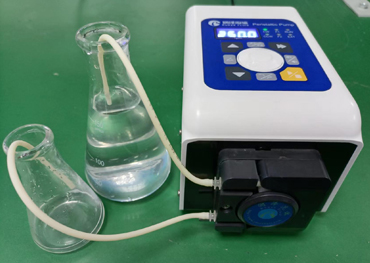
Tubing inner diameter influences volume per revolution, fluid velocity, pressure loss, priming behavior, and the speed needed to reach a target flow. It should be selected with the compatible pump head and wall thickness, not as an isolated dimension.
The objective is usually to place the normal operating point away from both the drive's lowest controllable speed and its maximum continuous duty condition.
Start from the required operating range
Define minimum, normal, and maximum flow, then review reference flow data for tubing sizes approved for the pump head. Select candidates that cover the range with useful speed margin and acceptable resolution at the low end.
A larger bore may reduce required speed but can increase each pulse volume and reduce fine adjustment. A smaller bore may improve resolution but require higher speed, increasing wear or limiting maximum flow.
Review pressure and fluid effects
Small internal diameters increase velocity and line loss for a given flow. Viscosity, line length, fittings, suction lift, and outlet restrictions can therefore shift the useful range away from an open-discharge estimate.
Confirm the selected tubing material, hardness, and wall thickness are supported by the head. The outside dimension and compressive behavior control occlusion even when the internal diameter appears correct.
Compare candidates experimentally
Test at the minimum and maximum required flows using the real liquid path. Measure flow stability, pulsation, motor load, priming, tube temperature, and drift over representative operating time.
Reference flow values are commonly measured with water under stated laboratory conditions and are not a guarantee for another fluid path. Verify the current manual, selected tubing part number, and application conditions before release.
- Keep enough speed margin for calibration and process variation.
- Evaluate pulsation as well as average flow.
- Document tubing dimensions by controlled part number, not a nominal bore alone.
Engineering takeaways
- Choose inner diameter from the full flow range and usable speed window.
- Include wall thickness, material, and pump-head compatibility.
- Validate with the actual fluid, pressure, and duty cycle.