
Syringe Pump Installation Orientation: Upright or Inverted?
Choose an installation orientation by evaluating air management, leakage containment, maintenance access, and instrument geometry.
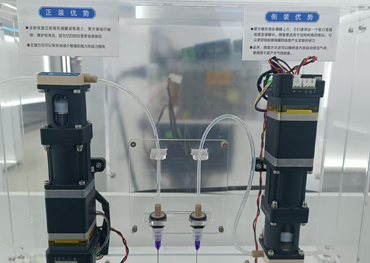
There is no universal upright-or-inverted rule for every syringe pump. Orientation should be selected from the fluid, gas-management, leakage, maintenance, and enclosure requirements of the instrument.
Before choosing, confirm the orientations permitted by the current pump and syringe documentation. A mechanically convenient position is not acceptable if it conflicts with the product's operating limits.
Manage air and priming
Gas rises to the highest local point in a liquid path. Place the syringe ports and connected tubing so bubbles can be intentionally purged rather than trapped near the outlet or valve. The best orientation can differ between aspiration and dispensing phases.
For small-volume delivery, even a small bubble can add compliance and delay pressure transmission. Evaluate the complete line, including high loops, dead legs, valve cavities, and fittings, rather than looking only at the syringe body.
Plan for leakage and service access
Consider where liquid will travel if a connection loosens or a seal fails. The selected orientation should keep leaks away from the motor, encoder, controller, power connections, and other sensitive parts. Add a drain path or containment feature when the risk analysis requires it.
Technicians also need access to the syringe, valve head, fasteners, and connectors without applying side load. Leave room for removal tools and define how the fluid path is depressurized before service.
Verify orientation in the instrument
Test priming, bubble clearance, refill, dispense, valve switching, and leak containment in the final enclosure. Include shipping vibration and instrument leveling if those conditions can change fluid position.
Compare volume accuracy and repeatability after the system has reached its operating temperature. If performance differs by orientation, investigate trapped gas, tubing strain, valve loading, or inadequate mounting support before changing control calibration.
- Confirm allowed mounting positions in the current datasheet.
- Keep unsupported tubing from loading the syringe or valve ports.
- Document a repeatable priming and bubble-removal procedure.
Engineering takeaways
- Choose orientation from system behavior, not appearance.
- Prioritize bubble removal, leak containment, and serviceability.
- Validate the selected position in the final enclosure and duty cycle.